
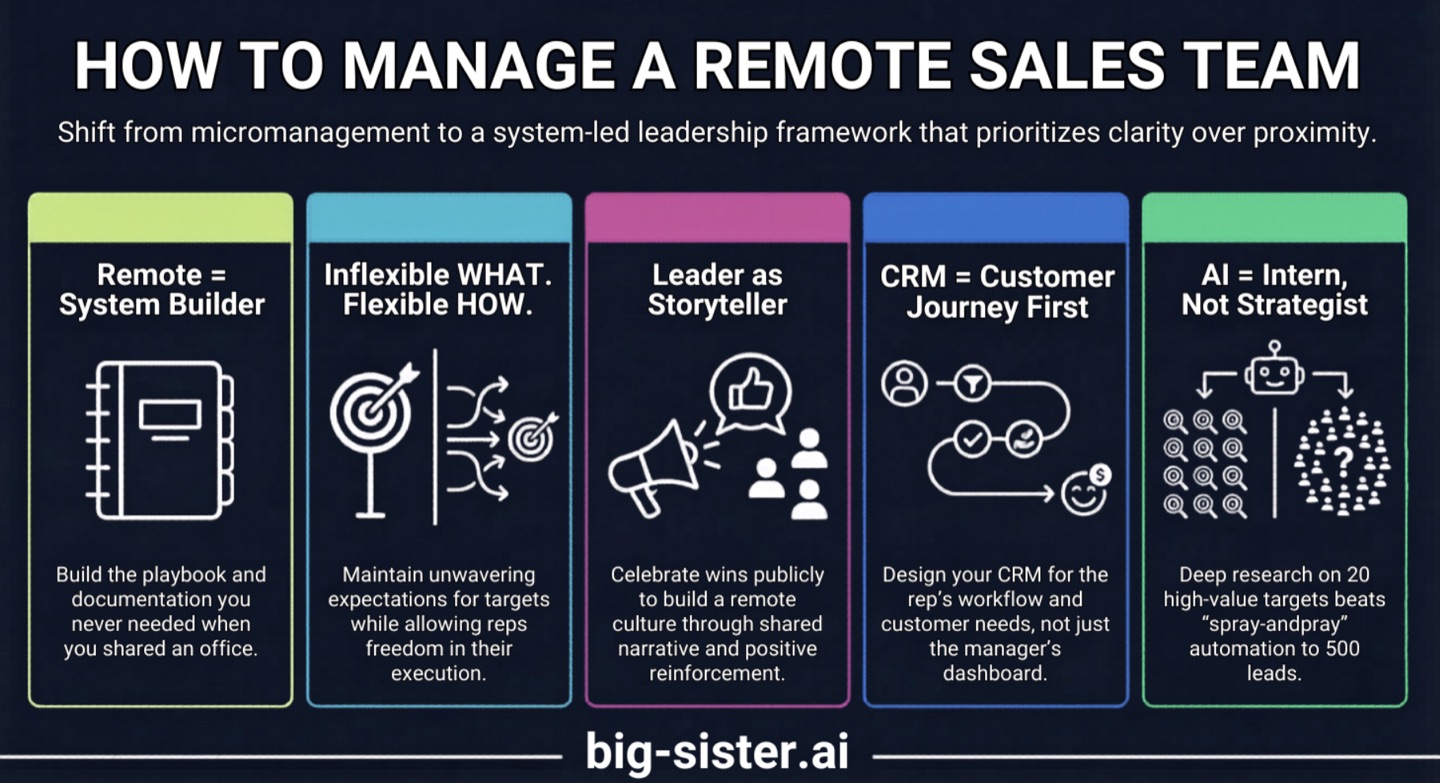
Most sales managers who struggle with managing a remote sales team think they have a communication problem. They don't. They have a clarity problem - and communication is just where it shows up.
When your team sits in the same office, you absorb context by proximity. You catch problems before they compound. Take that away, and suddenly the informal systems that held everything together are gone - and most managers scramble to replace them with more check-ins, more reporting, more pressure. That usually makes things worse.
Remote sales management is a fundamentally different discipline - not harder than in-person, but less forgiving. This guide gives you a practical framework for managing remote salespeople without reverting to micromanagement, built on conversations with three practitioners:
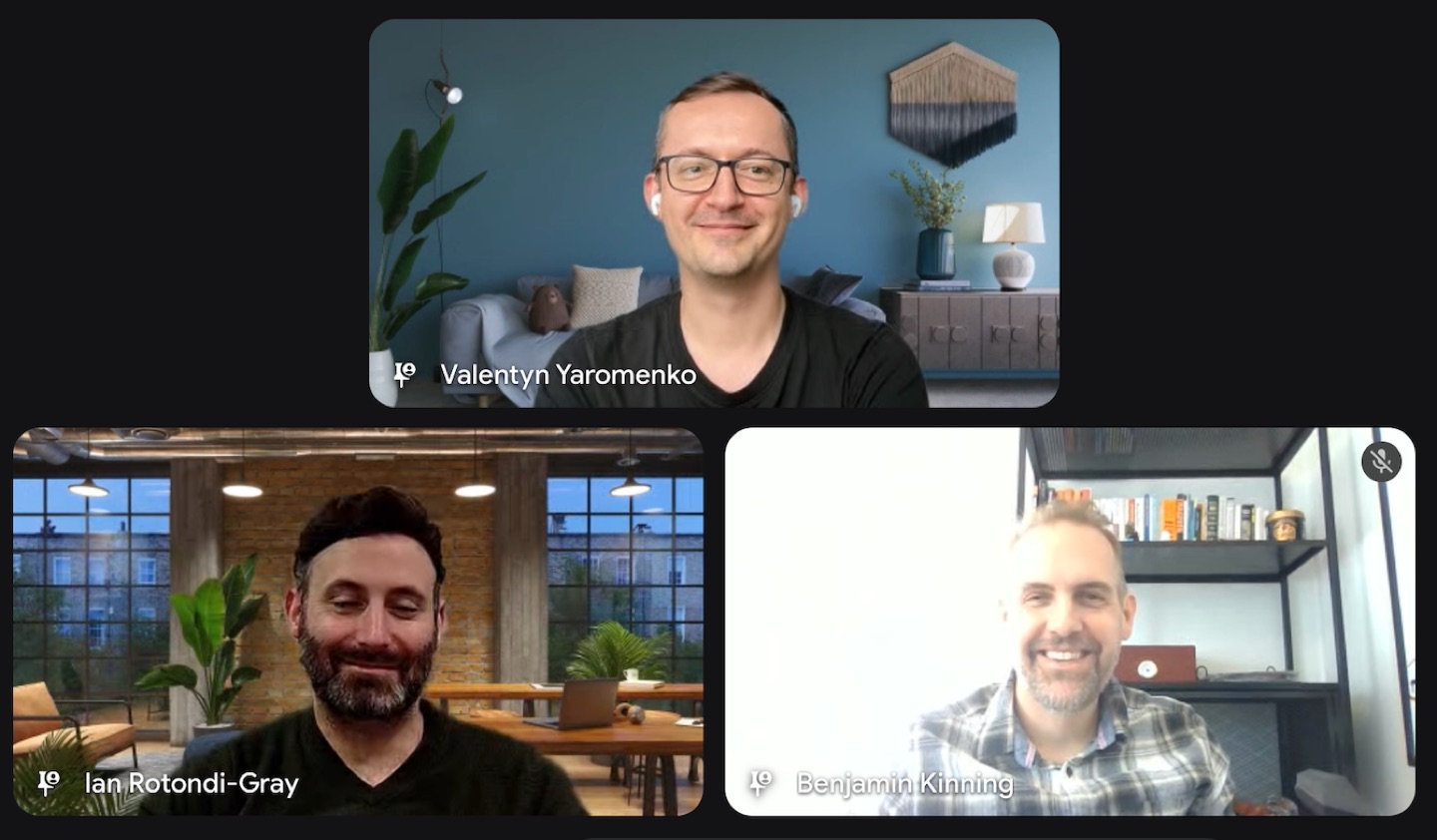
Ian Rotondi-Gray - former Palantir and Oracle sales and GTM leader, scaled enterprise teams across three continents.
Ben Kinning - fractional CRO with 20+ years managing distributed teams across 15 countries (Sales Geek Denver).
Moderator - Valentyn Yaromenko - CEO of Big Sister AI, fully remote sales operation for 8+ years, including through COVID and the war in Ukraine.
Managing a Remote Sales Team: Why the Rules Change
Before jumping to tactics, it's worth getting the framing right. Remote sales management isn't harder than in-person - it's different. And one counterintuitive thing Valentyn Yaromenko points out from his own experience: remote can actually make your sales system stronger, if you let it.
"When you sit in one room with your team, you think you control everything. So maybe you don't need a CRM. Maybe you don't need a playbook - because you can answer any question right now. But when you build a remote team, you're forced: I need onboarding, I need accountability systems, I need documentation. Remote is a booster for sales system evolution."
- Valentyn Yaromenko, CEO of Big Sister AI (8+ years fully remote)
The key insight: proximity is not the same as clarity. The managers who struggle most with remote aren't missing tools - they're missing the systems they never had to build when everyone was in the same room.
Ian Rotondi-Gray, who led GTM teams at Palantir and Oracle across three continents, adds the nuance: in-person management has its own failure modes that are easy to ignore. Accountability conversations with body language in the room can actually be harder to navigate than a focused call.
"It's not like being in person absolves you of that responsibility. As a matter of fact, in person, it might even be harder."
- Ian Rotondi-Gray, GTM Executive, former Palantir & Oracle
How to Set Accountability Standards for Remote Sales Reps
The most actionable process framework came from Ben Kinning, who built and scaled distributed sales systems for Western Union across 15 countries.
"Be inflexible with the “what”, but flexible with the “how”. Having very clear expectations of what is to be accomplished by when - that needs to be unwavering and talked about in every single meeting, regardless of where people sit in the organization."
- Ben Kinning, Fractional CRO & Certified Master Sales Trainer, Sales Geek Denver
The “what” is the outcome: the number, the quota, the target. Every remote sales rep should be able to state it without hesitation.
The “how” is where you give people room - different reps approach their targets differently, and a distributed team actually surfaces more experimentation than a single office does.
Build a deliberate feedback loop so what's working gets shared across the team. In an office, it spreads naturally. In a remote team, you have to engineer it - a short "what worked this week" slot in your team call, an async Slack thread, a monthly roundup. Whatever the format, the goal is the same: turn individual experimentation into collective learning.
Remote Sales Team Accountability Without Micromanagement
One of the most practically useful ideas in the conversation came from Ian Rotondi-Gray-the concept of the leader as storyteller.
"The leader sees part of their role as being a storyteller of the team. Selflessly giving of themselves in that way - folks naturally gravitate toward that. That's part of what creates a culture over time."
- Ian Rotondi-Gray, GTM Executive, former Palantir & Oracle
This has a specific implication for the accountability of the remote sales team. The failure mode Ben Kinning sees most often in remote leadership: managers who only reach out when they need something. Pipeline update before a board meeting. A check-in when a deal slips. That pattern conditions reps to associate contact with bad news - and they start going quiet.
The fix is deceptively simple: reach out when there's nothing wrong.
"When's the last time a leader reached out and said, "Hey, you're doing a really good job - I want to take 30 minutes to hear what's working for you and how we can highlight that through the organization"? It is a very rare thing. Think about the impact that provides for morale and development."
- Ben Kinning, Fractional CRO & Certified Master Sales Trainer, Sales Geek Denver
The practical move: block time each week for non-agenda conversations with remote reps. Not performance reviews. Ask what's going well before asking what isn't. This isn't soft management - it's the infrastructure that makes accountability conversations land when you need them.
CRM Adoption for Remote Sales Teams: What's Actually Broken
One of the most consistent frustrations with remote sales management is CRM adoption. Reps don't use it. Data is stale. Leaders can't trust the pipeline view. The diagnosis is sharp.
"Salespeople have revolted against filling out their CRM because they look at it as a babysitting exercise - a way to be big brother and keep an eye on everything they're doing."
- Ben Kinning, Fractional CRO & Certified Master Sales Trainer, Sales Geek Denver
"If you do not have a unified value system and workflow about where and when to use a CRM, they aren't useless - but they're close to useless. They're literally just for the leaders."
- Ian Rotondi-Gray, GTM Executive, former Palantir & Oracle
The fix: start with the customer journey, not the leadership dashboard.
"We try to measure what the process looks like today, and then we try to measure the ideal customer journey - what the customer prefers to see in the buying process. And then we understand what to implement in the CRM. Because it's not for the salespeople or for some smart people in the company - it's for the customer. Simplify the customer process, and then the CRM makes sense to the rep too. They're not filling forms for their boss - they're working with the customer."
- Valentyn Yaromenko, CEO of Big Sister AI
Audit your CRM for who it actually serves. If every required field maps to a leadership report rather than rep workflow, that's your problem. You can read more about how sales managers use performance data to coach without micromanaging - and what that looks like in practice.
Using AI to Manage Remote Sales Team Performance
The conversation spent significant time on AI - and the frameworks here are more nuanced than the usual "automate your outreach" advice.
"Think of AI as an intern in your company. It's not your head of strategy. It's an intern level. You'd say: "Hey intern, I want to meet with the VP of so-and-so - please go research what's important to them, what the buying signals are, what questions to ask."
- Ben Kinning, Fractional CRO & Certified Master Sales Trainer, Sales Geek Denver
The failure mode is using AI to scale laziness.
"Bad use of AI right now is it being used to scale laziness - generic automation-based messaging, spray and pray. If everyone looks at their LinkedIn inbox, you've probably got 10 sitting there today that all say the same thing."
- Ben Kinning, Fractional CRO & Certified Master Sales Trainer, Sales Geek Denver
Sending 500 AI-generated messages a week isn't scaling sales - it's scaling noise.
Valentyn Yaromenko adds a dimension that's particularly relevant for remote teams: AI as a process enforcer and coach.
"If you have the rules, if you have the processes, if you have a playbook - AI can act like a kind boss who helps and leads you. Before, you needed to use your memory and train the whole team to control each other. Now AI can have that level of support and just remind everyone if they're doing something outside the algorithm."
- Valentyn Yaromenko, CEO of Big Sister AI
The effective use of AI in remote sales team management is the opposite of automation: use it to make fewer conversations significantly better, and to enforce the process standards that are harder to maintain when nobody's in the same room.
For sales managers: AI is beginning to close a gap that has existed for years. As Ben Kinning puts it, "Today, CRMs are just measuring activity levels. Person A did 20 more calls than person B - that's all I have access to. The effectiveness of those conversations is what's missing." That's the next layer - and it's where Big Sister AI tracks performance across 40+ signals, not just activity counts.
How to Hire Remote Sales Reps Who Don't Need to Be Managed
The conversation ended with a practical hiring question, and two qualities came up independently from both speakers.
Ian Rotondi-Gray's pick: authentic curiosity.
"A curious person is going to dig into what is the best intersection of what we sell with genuinely solving our prospects' challenge sets. If you're not already sussing that out in your interviews, that's my number one from Monday."
- Ian Rotondi-Gray, GTM Executive, former Palantir & Oracle
In a remote environment, curiosity also predicts self-direction - curious people figure things out without someone watching.
Ben Kinning's pick: resourcefulness.
"Someone in a remote-based position needs to be a self-starter who will find a way to figure it out - because it's harder to observe others when you're remote. People who have this natural problem-solving ability usually find a way to get it done."
- Ben Kinning, Fractional CRO & Certified Master Sales Trainer, Sales Geek Denver
Both qualities point to the same underlying thing: someone who doesn't need to be managed - they need to be led. That's a different screen than most sales interview rubrics are built around, and it matters more in a remote context than almost anything else.
What to Do on Monday
If you manage a remote sales team and want to improve remote sales team productivity this week:
- Audit your communication patterns. How often are you reaching out for reasons other than extracting information? If the ratio is off, fix that before anything else.
- Check whether your team can state the target without hesitation. If the “what” isn't crystal clear, the how doesn't matter.
- Look at your CRM honestly. If adoption is below 70%, you probably have a design problem - not a training problem. Go back to the customer journey.
If you're still building the sales system itself - start here: From Founder-Led Sales to a Team That Sells Without You → - Pick one rep who's doing something that's working and tell that story to the wider team. Make it specific. Make it repeatable.
That's not a full remote sales management system. But it's where the system starts.
Want more frameworks like these? We run regular Sales OStin sessions where experienced sales leaders share what's actually working in the field. Join our events calendar and be the first to know about upcoming conversations.
If you're trying to understand what your remote reps are actually doing - not just how many calls they're logging, but how effective those conversations are - that's exactly what Big Sister AI is built for. We score rep performance across 40+ signals so you can coach on what moves the needle, not on gut feel. Book a demo →
Watch the Full Conversation:
Frameworks from:
Ian Rotondi-Gray - Commercialization & GTM Executive, former Palantir and Oracle
Ben Kinning - Fractional CRO & Certified Master Sales Trainer, Sales Geek Denver
Valentyn Yaromenko - CEO, Big Sister AI
Sales OStin online session - March 11, 2026