From Founder-Led Sales to a Team That Sells Without You
Most founders are stuck in founder-led sales longer than they should be. Which one are you?
"I close all the big deals. My team can't replicate it."
"Every time I step back, the pipeline dries up."
"I've tried hiring salespeople. It never works."
"Sales isn't my thing — I need to find someone who can do it."
"I've been building for a year. Now I need to go sell."
"I'd rather hire an expert than figure this out myself."
Both are stuck. Both follow the same path out. Here's what that path looks like.
- Why founders get stuck in sales (and why it's not laziness)
- Stage 1: Sell it yourself — completely
- Stage 2: Narrow down ruthlessly — find your real ICP (Ideal Customer Profile)
- Stage 3: Build the sales playbook before you hire anyone
- Stage 4: How to hire your first salesperson
- Stage 5: Change your role — stay in the engine
- Stage 6: Layer in AI where the process is proven
- How to know which stage you're at right now
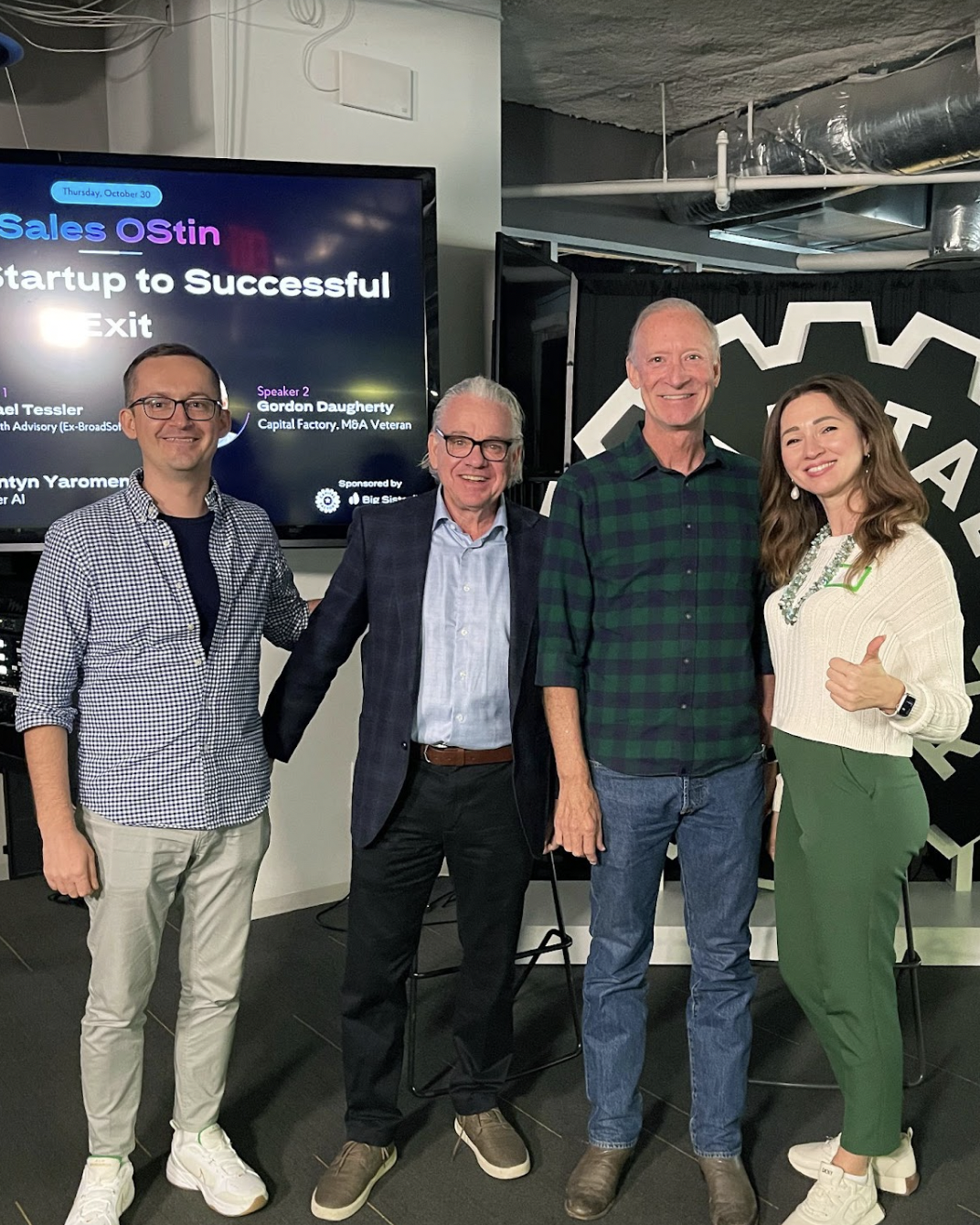
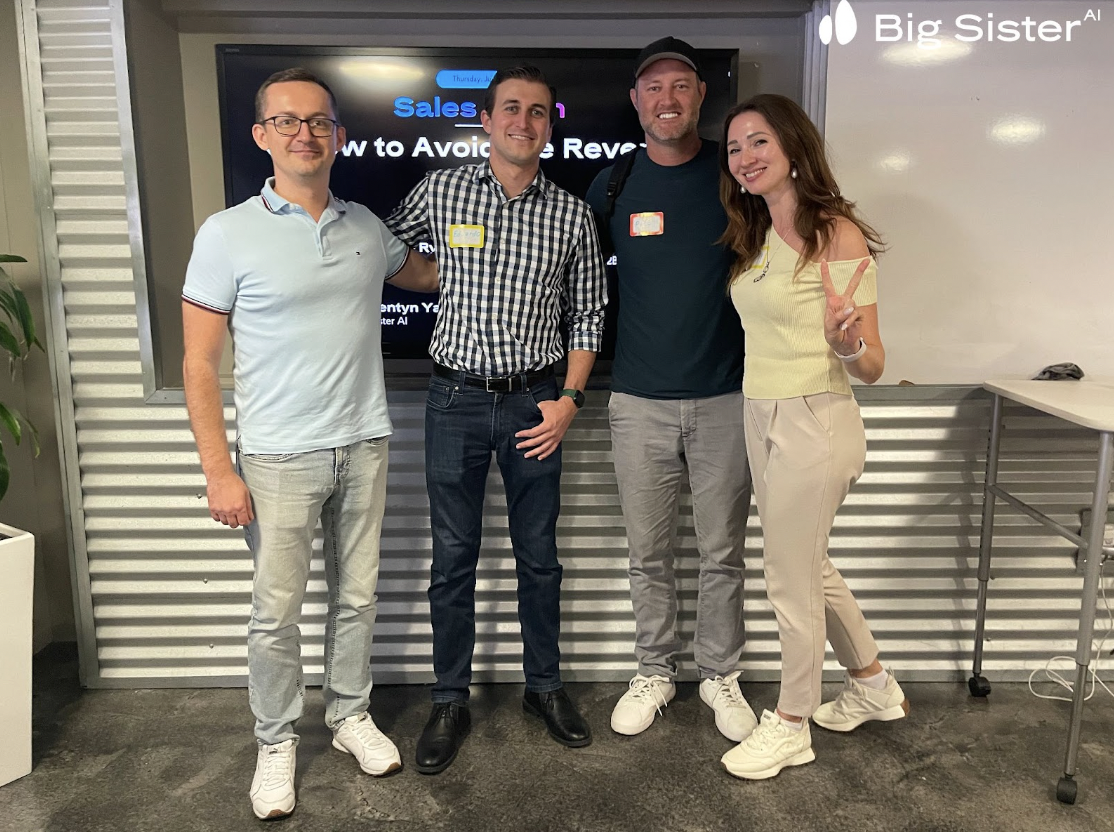
At a recent Sales OStin event in Austin, two founders who've built and sold companies — multiple times — sat down for an honest conversation about this transition. Sam Goodner built Catapult Systems into the world's #1 Microsoft integrator before selling it, then scaled Flash Parking from $3M to $100M in revenue with a unicorn valuation. He's also the author of Like Clockwork — a framework for running a business with operational precision. Yagub (Jacob) Rahimov — self-described "Mr. Paranoid" — hired 1,400 salespeople at a Cyprus-based brokerage that reached $178 billion in monthly turnover in 16 months, exited two companies, and is currently building Polygraf AI across 18 countries.

The conversation was moderated by Valentyn Yaromenko, Co-founder & CEO of White Sales and Big Sister AI, who has spent over 18 years building sales systems for client companies. His questions shaped the structure of the evening — and his perspective, as someone who builds sales organizations for a living, runs through every stage of this guide.
What follows is organized into the stages you actually need to go through — in the order that matters.
Why founders get stuck in sales (and why it's not laziness)
The event was called "How to Fire Yourself from Sales." Yaqub's first response when he heard the topic:
Sam's response wasn't a disagreement — it was a clarification:
So here's what they actually agree on: the founder never fully stops owning sales. What changes is the form of that ownership. The real mistake isn't staying involved — it's staying involved in the same way forever, doing the same jobs that should have been handed off years ago.
Stage 1
Sell it yourself — completely
Every founder-led sales process that eventually runs without the founder was built by one. There's no shortcut — and this is where both founder types need to start, for completely different reasons.
If you're Type 1 (the founder who is the sales team): you're probably already here. The question is whether you've treated these sales as research — documenting patterns, testing messages, understanding exactly why deals close — or whether you've just been closing.
If you're Type 2 (the technical founder who's been avoiding sales): this stage is non-negotiable. Not because you need to become a salesperson, but because talking to customers is the only way to find out whether what you've built solves a real problem.
When you're selling, you're doing research that can't be done any other way. You're learning who actually buys (not who you think will), what their real objections are, what language they use, what makes them say yes, and what makes them disappear.
This stage is supposed to be messy. Sam calls it the "shotgun approach" — and that's not a failure, it's the only way to build the data you'll need later.
Stage 2
Narrow down ruthlessly — find your real ICP (Ideal Customer Profile)
Early on, you say yes to almost everything. That's correct and necessary. But there's a moment where the breadth that kept you alive starts to work against you.
The discipline of this stage is saying no.
Yaqub pushes for precision. If you think you have multiple ICPs, you probably don't have one yet:
Stage 3
Build the sales playbook before you hire anyone
This is the most skipped stage. It's also the reason most first sales hires fail.
You've been selling successfully for months or years. But almost everything you know lives in your head — the objection handling, the stories that land, the way you read when a deal is going cold. Your new hire hasn't done any of that yet and can't get it by osmosis.
Sam's analogy for why you can't skip this step:
Sam's approach to building operational systems is also the foundation of his book Like Clockwork. A sales playbook for a startup doesn't have to be a 50-page document. At minimum, it needs to answer:
- ICP definition — specific role, title, company size, industry of your buyer
- How to reach them — email, LinkedIn, events, referrals — what actually works
- The sales stages — what happens at each step from first touch to close
- Common objections and responses — the exact language that moves deals forward
- Proposal and pricing structure — standardized, not reinvented per deal
- Qualification criteria — how you decide whether a lead is worth pursuing
Yaqub's approach before making a full hire is a structured affiliate trial — he gives candidates a high-commission opportunity (up to 50%) and watches whether they go after the right person or spray and pray:
.jpg)
Stage 4
How to hire your first salesperson
With a playbook and a clear ICP, you're ready to hire. Now the question is who — and both speakers were unusually aligned here.
Neither has a single formula for who to hire. What they agree on: the founder has an unfair advantage that your first hire will never fully match — so you have to be smart about how you calibrate expectations.
But there is one thing I believe all successful sales people have in common — no exception. I call it being 'coin-operated.' They have to really want to make money.
Not every human is motivated by money — I'm not, and most engineers aren't — but a salesperson must be. Otherwise, there is no way they can deal with the rejection. I want my sales people to drive a car that's too expensive for them and wear a Rolex. I need them to have maxed-out credit cards and a hunger to go make money at all costs. That's what keeps them dialing for dollars and getting 99 'nos' just to get to one 'yes'."
Yaqub ran a company with 1,400 salespeople. His motivation system was extreme — and it worked:
But money motivation alone isn't enough. The other non-negotiable:
Yaqub also runs a stress test: he tells an existing client to act as if a deal is collapsing — then watches how the candidate responds. "I'm looking: do they get defensive, or do they find a solution?"
Stage 5
Change your role — stay in the engine
This is the stage where leaving founder-led sales becomes real. The founder's role doesn't disappear — it shifts. From doing the work to steering the system.
What changes here isn't the principle — it's the mechanics. Here's what that actually looks like in practice.
Yaqub — with a two-person sales team today — still joins every call that's about to close, usually without speaking:
Yaqub's simple test for whether the transition has actually happened:
Sam makes the case for why this transition matters — especially for founders with an exit in mind. He's built and sold multiple companies, so he's seen this from both sides of the table:
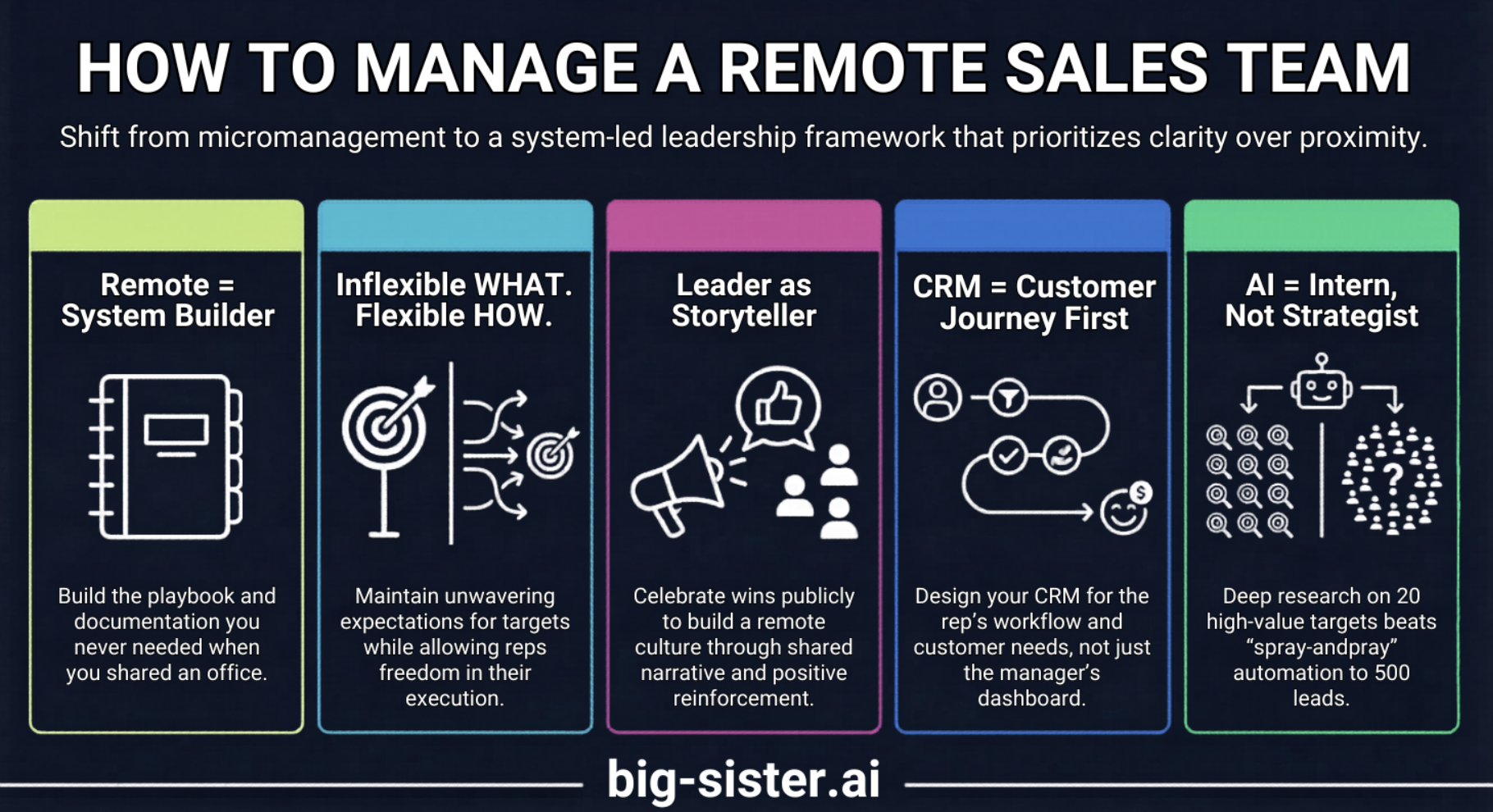
If your team is remote or distributed — the management challenge is different. How to manage a remote sales team without micromanaging →
Stage 6 — optional but increasingly necessary
Layer in AI where the process is proven
This came up at the end of the conversation, and the sequencing matters.
Yaqub currently runs Polygraf AI with 20 humans and close to 5,000 AI agents. He recently let go of six people in one function because an automated system outperformed the human team by 20–40%. He launched a product in Japan with a single person and 800 agents. Sam knows founders running $100M revenue businesses with eight employees and 2,500 AI agents — handling lead generation, email, Q&A — flipping to a human only at closing.
Both are clear: the AI executes the playbook. It doesn't replace it.
Sam's closing point brings it full circle — and it applies to AI just as much as to people:
The opportunity is real: if you've done Stages 1–5, AI agents can operate significant parts of your top-of-funnel at a fraction of the cost of a human team. But the playbook has to exist first. You can't automate chaos.
Want to see what AI actually looks like inside a sales process that's already working? Why AI Fails Your Sales Team — and What to Fix First →
.jpg)
How to know which stage you're at right now
The founders who stay stuck in founder-led sales longest usually didn't fail at hiring or at building a team. They failed at one of the earlier stages — tried to skip the process, hired before they had a playbook, delegated before they understood the ICP, handed off before they understood what they were handing off.
The good news: the stages are fixable in any order. If you know which one you skipped, you can go back and do it now.
The 5 (+1) stages of moving from founder-led sales to a team that sells without you:
- Sell it yourself — completely, until you know exactly what works and why
- Narrow down — find your real ICP, say no to everything else
- Build the playbook — codify what you know so someone else can do it
- Hire for hunger — coin-operated, adaptable, tested before fully committed
- Change your role — stay in the engine, stop running the plays
- Layer in AI — once the process is proven, not before
The question Yaqub asks himself to know when a stage is complete: how much does the business need you right now? If the answer is "completely" — you know what to fix next.
.jpg)
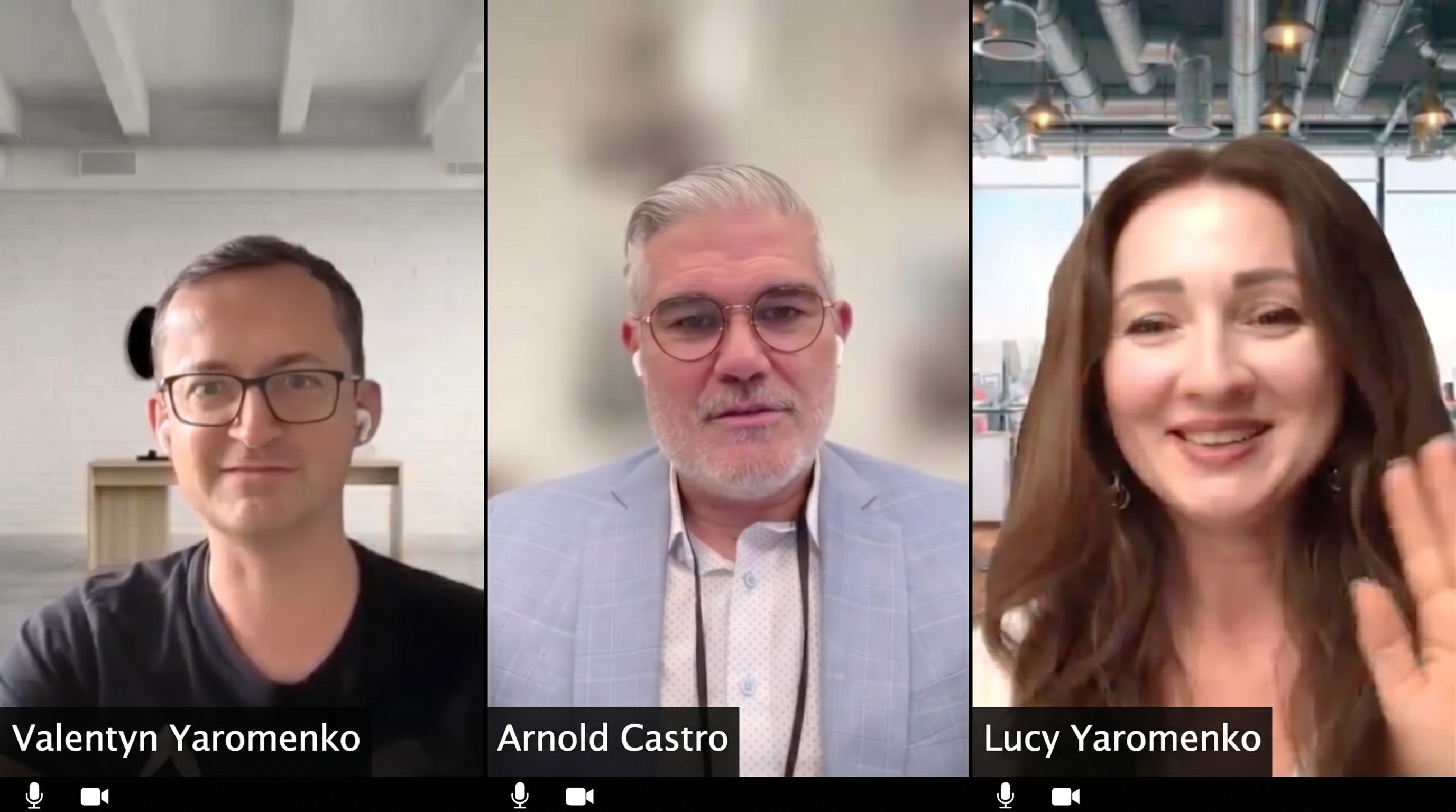
Watch the Full Conversation
This article was written by Lucy Yaromenko, Co-founder & COO of Big Sister AI — an AI platform that analyzes every customer interaction to score your team's performance against your sales playbook, so founders can step back from sales without flying blind. See how it works →
This article is based on a live conversation at Sales OStin — a monthly event for founders and sales practitioners in Austin, TX, hosted at Capital Factory.
Want to see how Big Sister AI helps founders build a sales process that runs without them? Start here.
Want to join future events? Subscribe to the Sales OStin calendar and get notified about upcoming online and in-person events: luma.com/salesostin →


.jpg)



.jpg)