
Let me start with two numbers, because they explain almost everything about how to implement AI in a sales team, and why most attempts go sideways.
87% of sales organizations now use AI.
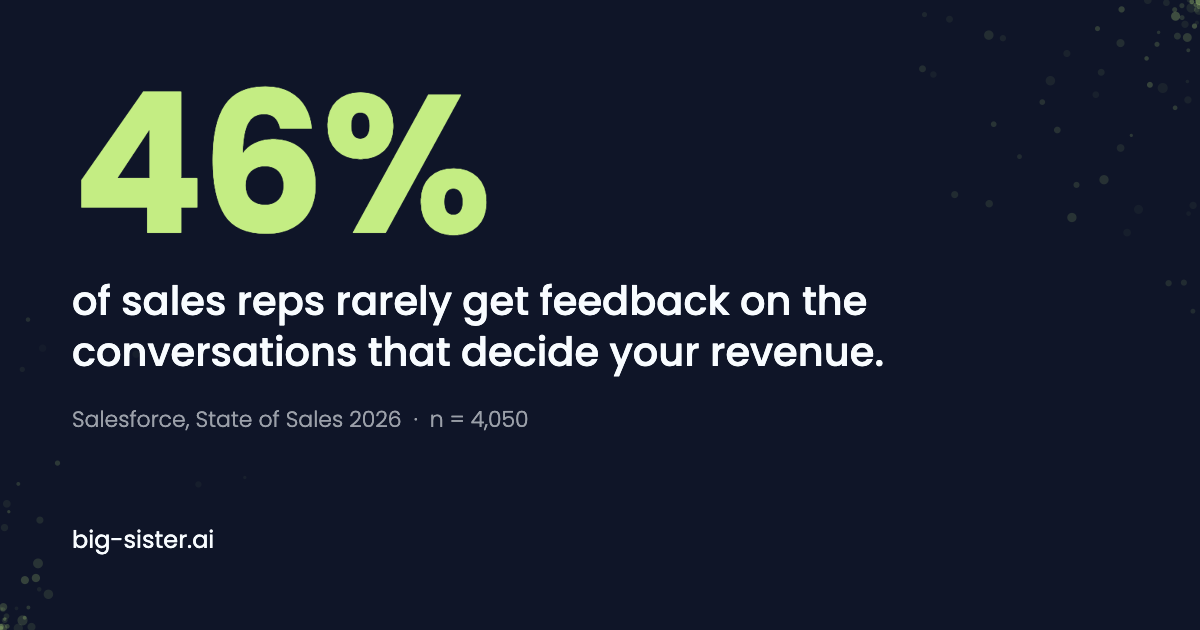
46% of sales reps say they rarely get feedback on their sales conversations.
Same report. Salesforce, 2026, 4,050 sales professionals. Read those two lines again and notice that nobody finds it strange.
Almost everyone bought the technology. Almost half the reps still cannot tell you whether yesterday's call was any good.
How did that happen? AI went where it was easy to point it. Notes. Summaries. CRM cleanup. Draft emails. Forecast rollups.
All useful. None of it touches the thing that actually decides your revenue, which is what happens in the conversation, and whether anyone is getting better at it.
So here is my answer when a founder asks me where to start. Build most of it yourself, this month, and do not wait for a vendor. But keep one piece outside the prompt, because a ruler that changes shape cannot measure growth.
Let me walk through it the way I do on a call.
First, the question nobody wants to answer
Forget tools for a minute. I am going to ask you what I ask every client.
What is a good sales conversation in your company?
Not the vibe. The specifics. If I gave the same recording to your two best managers, would they grade it the same way? Would they even agree on what to look at?
Almost nobody can answer this. And that one gap explains most of the mess downstream.
"Be more consultative" is not an instruction. Nobody has ever improved from it.
You cannot tell whether your new AI tool helped, because you had no measurement before it arrived.
You cannot decide who to invest in and who to move, because the only evidence you have is a feeling plus the number at the bottom of the quarter, which shows up far too late to do anything about.
And that 46% getting no feedback? Their managers are not lazy. Listening to calls properly is expensive, and there is nothing to listen against. So it does not happen.
People say sales has a reliability problem. It does not. It has a reliability vacuum. Nothing is there.
Fill that first. Everything after it gets easier, including the AI.
By the way, the usual complaints are real too. In that same Salesforce data, 51% of leaders using AI blame disconnected systems, and the average seller spends only 40% of their time actually selling. Pendo's research says 67% of software features companies pay for are never used at all. But those are symptoms. The vacuum is the disease.
Second, write the process down. Yes, on paper.
The first thing you build is not software. It is a document, and it costs nothing.
Think about your pipeline as the life of a deal. A lead shows up, you do something, you agree the next stage, then the next one. In a CRM it stays almost a straight line on purpose, because a human being has to hold it in their head.
Every stage has a job. And the job that decides everything is the conversation.
Here is the example I use, and I have never had it fail to land.
Henry Ford, a hundred years ago. His problem was not ambition, it was that nobody walking down the street knew how to build a car. Hire someone and you would spend six months teaching them mechanics before they were any use to you.
So he did something almost stupid in how simple it was. He chopped one complicated job into a line of small ones. Now anybody could stand at one table, under one sign: take this bolt, take this nut, screw them together, pass it down.
That is what a sales script actually is. Not a speech. A sign above the table.
And this is why the word causes so much trouble. Someone says "script" and everybody pictures a call-centre operator reading a page out loud in a dead voice. That is the worst version of the idea. It gives the whole thing a bad name.
Two rules stop your team from hating it:
The words are theirs. You write what has to be achieved at this stage. Each rep says it in their own vocabulary, so it does not sound memorised. Rule fixed, wording free.
Aim at McDonald's. Walk into one in any country, any city. You already know how it will go and what they will ask you. That is not boring, it is comfortable, for you and for them. It is the best example on earth of a process where the result is expected. It also takes years, so start now.
Call the finished thing a playbook, not a script library. Short. Stages named. For each stage, the few things a rep actually has to do.
Third, understand why the document alone does nothing
This is the part that surprises people, so stay with me.
Most playbooks die in a shared drive. Everyone read it. Nothing changed. Why?
Two things can happen inside a person when something lands on them. Either they think about it consciously and work out a fresh answer, or something already installed just fires.
Reflexes are what you were born with. Skills are the things you learned so well that the response is already loaded and waiting.
Now, a question. What share of your day are you genuinely conscious? Really deciding, not running on autopilot.
Most people guess 30% or 40%. The number I use is under 10%. Usually closer to 2 to 5%. And 10% is the ceiling, on the kind of day that leaves you wrecked by dinner.
You probably already know this from driving. Two hours on the road and no memory of it. Gears, mirrors, indicators, all of it happening without you.
But notice the other half of that example. Autopilot is only good if somebody installed it properly. Whether you were taught the rules of the road decides whether you arrive at all.
Now put your best rep in that frame.
Your smartest, most experienced seller is also running at 10%. On a live call, the odds that they are consciously reasoning their way through it are low. The second they hear a familiar phrase, out comes whatever is installed: something from their last job, a line from a book, a habit from how they were raised.
They will perform exactly as installed. Not as instructed. As installed.
If you want that to change, you have to rewrite what is in there, and then check whether the rewrite actually took.
This is the same reason your own AI setup works, by the way. Strip out the prompts and the skills and it gets noticeably worse at your work. The model did not get dumber. You removed the instructions that made it useful on your problem.
People run on identical logic. That is why you need the playbook, and why the playbook is not enough.
The cheapest example I know
Let me prove it with the smallest possible skill.
Before a call ends, the rep agrees the next contact. A specific day. A specific time.
That is it. That is the whole skill.
Here is the version most reps run:
"Great, I will give you a shout next week."
And here is the version that works:
"Does Tuesday work for you? Early afternoon? Three o'clock? Perfect, I will call you Tuesday at three."
Feel the difference? The first one produces a rep phoning on Monday, apologising for interrupting, asking if now is a good time. It is never a good time. You already had plans for that moment.
In our client work, simply starting to control that one behaviour tends to move conversion somewhere around 40 to 50%. That is what we see across projects, not a published study, and it holds up often enough that I lead with it.
Now the uncomfortable bit. Every single person reading this already knew it. Your reps know it. Ask them and they will tell you, with total confidence, that they do it on every call.
They do not.
Knowledge was never the problem. Nothing measured it, so nothing changed.
Fourth, build the easy part yourself
Playbook written? Good. Now most of the useful AI work is within reach of one sharp operations person and a corporate AI account.
Start with reporting, because it pays you back immediately. Connect the CRM. Where do leads come from, what does each one cost, how many convert, what is the return per campaign.
Then a short morning note to each rep. What you did yesterday. What you did not get to. Are your weekly numbers on track. Which accounts have had nothing scheduled for a week.
Then the writing. Follow-ups, offer updates, meeting prep pulled straight from the deal record.
Why build instead of buy here? Speed. You rewrite the prompt, adjust the skill, and the new version is live that afternoon. No vendor roadmap on earth competes with that. I do exactly this for my own calls.
Anyone telling you not to build this is selling you something.
Two conditions though, and both are about control rather than clever.
Corporate accounts, never personal ones. If your customers' conversations are piling up inside one employee's private account, that is not untidiness, it is exposure. Your lawyers will care. It costs a few dollars more a seat, and the fight you will have internally is about paperwork, not money.
Use the organisation level. On a business plan you decide what your people can connect, and you can hand the whole team one shared set of instructions instead of forty private setups nobody can see. Write it once, so a rep who asks "how do I handle this" gets an answer that reads your playbook first, checks the deal record second, and only then opens its mouth.
Think about where control used to live. Yesterday, the mission control panel in sales was the CRM. For a lot of teams it is now the assistant. And almost nobody has governed it.
Agents come after all of this. Once there is a written process, CRM access and somewhere to keep memory, sure, let an agent pull market context, update records, draft the follow-up, refresh the offer. Agents on a defined process compound. Agents on an undefined one produce confident work that nobody can check.
Fifth, the one piece that cannot live in a prompt
Here is where I argue against the do-it-yourself approach, and it is one specific thing.
Try this experiment. Take ten calls. Run them through your setup today and read the feedback. Now run the same ten next week.
You will get different answers.
It moves when you touch the prompt, and it moves a little on its own. That is not a knock on any particular model, and swapping models will not save you. Ask any general model to grade something and it will drift, unless there is a fixed rubric underneath it and a stored pile of worked examples deciding what a 2 looks like and what a 4 looks like.
Fine when you are the only reader and you know what you asked for. Not fine as the basis for telling a human being how they are performing.
And the worst case is not a wrong number. It is a genuinely good call marked down, or a bad call praised and held up as the example everyone should copy.
Two more things a prompt cannot give you:
Something to compare against. A score means nothing on its own. It means something across reps, across quarters, against a standard nobody can quietly edit halfway through the quarter. That needs the rubric frozen, plus a memory layer, plus somewhere the data piles up. It also needs the rubric to know your pipeline. If it tells a rep to offer a discount at a stage where presenting was forbidden and briefing was the entire job, that feedback is worse than useless. It is confidently wrong in exactly the direction you were trying to fix.
A way to argue. A rep who thinks the score is wrong has to be able to say so and have a human look at it. Without that, your score is just an opinion with better grammar, and your team will treat it that way.
That is the layer we build, and the standard underneath it is the actual product. 18 skills, each on a 1 to 5 scale, rolling into one 0-100 Sales Score. Every score points at the timestamp in the transcript that earned it. Any rep can dispute a score, and more than 10% of interactions go to a second judge.
Anyone can prompt a model to grade a call. The appeals process is the part nobody else runs.
Simplest way I can put it: your CRM is the record. Your call recorder is the tape. We are the referee who scores every game.
The order, on one page
If you take nothing else from this, take the sequence. Most failed rollouts are the right pieces in the wrong order.
- Write the playbook. Stages, and what has to be achieved at each one. Free. Everything below depends on it.
- Move to corporate accounts and set the organisation level. Before anyone builds anything on top.
- Build reporting, digests and drafting yourself. Fast, cheap, pays back immediately, and you own the speed.
- Put measurement on a fixed standard, outside the prompt. This is what turns 46% getting no feedback into 100%.
- Add agents last. On top of the process, the records and the memory.
Steps one to three you can start this week, without us, and that is most of the value.
One last thought to leave you with. Most pipelines do not fall apart in Q4. They were already broken in Q2, quietly, one unagreed next step at a time. You just could not see it, because nobody was scoring.
When you get to step four and you want a number that survives being argued with by the rep it describes, book a demo. Bring one call you think went well. Those are always the interesting ones.
Sources: Salesforce, State of Sales Report 2026 (n=4,050, surveyed August to September 2025). Pendo research on unused software features, as cited in industry analysis. The next-step conversion range is a Big Sister AI and White Sales observation across client projects, not a published study.