
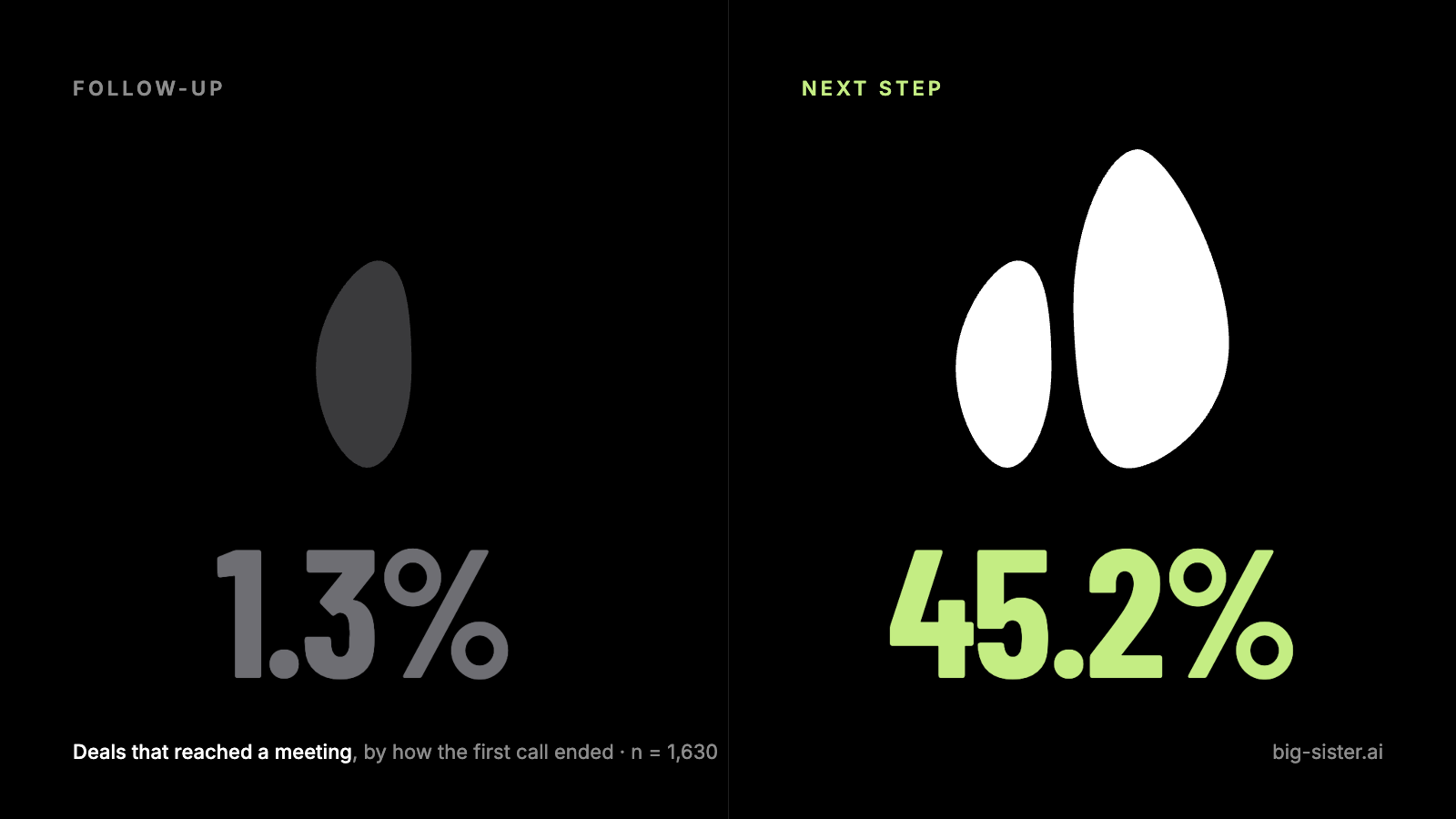
Most sales teams believe they run next steps. In the CRM, most of what is logged as a next step is a follow-up.
The two are different things, and the gap shows up in meetings booked and deals won.
We checked this against data. Big Sister scores every call and meeting on different skills. One of them is Next Step: how exactly did the conversation end? Over the last few months we scored 10,373 conversations across several sales teams. For one of those teams, we tracked every deal from the first call to its outcome.
Here is what we found.
The myth: "all our deals have a next step"
The Next Step scale is simple:
- 1 the conversation ended with nothing
- 2 "I'll call you" or "reach out if you have questions"
- 3 an action with no date: "let's talk next week"
- 4 the seller named a date and time, the buyer did not confirm
- 5 date and time named, buyer said yes out loud
Here is how the 10,373 conversations ended:
| How the conversation ended | Share |
|---|---|
| Nothing, or "I'll call you" (1-2) | 28.0% |
| Action without a date (3) | 46.6% |
| Seller's date, no buyer agreement (4) | 10.9% |
| Date, time and buyer agreement (5) | 14.6% |
Only 14.6% of conversations end with a real next step.
The other 85.4% end with a follow-up, in varying degrees of tidiness. Among teams with more than 1,000 scored conversations, the range runs from 4.6% to 19.9%. Even the best team gets there in one call out of five.
Next step vs follow-up: the difference
A follow-up is a one-sided action by the seller. Remind, email, "check in on the status." The buyer promised nothing. They may not even know you plan to call.
A next step is a mutual agreement. What happens, who owns it on each side, and when. It moves the deal to the next stage: a meeting, a demo, a CFO review, a signature.
One test settles it:
If the buyer doesn't know about the step, it isn't a next step.
"I'll call you Thursday" is a follow-up, even with a date. "Thursday at 3:00 you and your lawyer review the contract, I send the edits by Wednesday," followed by the buyer saying "yes," is a next step.
What it does to deals
We took one company's contact center, June to August 2026. We linked every scored call to its deal in the CRM and selected the 1,630 deals where the first scored call happened before the first meeting. We looked at outcomes as of September 28, which is 4 to 17 weeks later.
| How the first call ended | Deals | Reached a meeting | Won | Stalled* |
|---|---|---|---|---|
| Nothing, or "I'll call you" | 474 | 1.3% | 0.6% | 8.2% |
| Action without a date | 405 | 11.9% | 4.0% | 18.3% |
| Date, no buyer agreement | 368 | 19.8% | 3.3% | 12.8% |
| Confirmed next step | 383 | 45.2% | 5.0% | 3.9% |
*Deal still open, and the meeting never happened.
After a confirmed next step, 45.2% of deals reached a meeting. After a follow-up, 1.3%. The pattern is the same in July and in August on their own.
Speed differs too. After a confirmed next step, half of the meetings happened the same day. After "let's talk next week," the median was 2 days.
Look at the most expensive row: "action without a date." It is the most common way a call ends, and it produces the most stalled deals at 18.3%. Nobody said no, so the deal stays open with nothing behind it.
Two caveats. In many score-5 conversations the confirmed step is the meeting itself, so part of the effect is built into the definition. That is the point: an agreement the buyer confirmed gets kept, a seller's intention does not. And the sample has 50 won deals. The gap between 0.6% and 5.0% is clear, the gaps between scores 3, 4 and 5 are within noise, and we can't see a difference in cycle length, so we don't claim one.
How to log them in the calendar
A next step is an invite the buyer accepted, with an agenda and a desired outcome.
A follow-up is a task in your CRM, on your own calendar, with a real date. Not "sometime." "Thursday, 11:00, send the proposal."
You need both. The problem is using follow-ups as a substitute for next steps.
CRM hygiene: three signals a deal has gone quiet
1. Overdue
An overdue activity is a deal nobody is thinking about. The action was either not done or not logged. Either way, the manager can't see the real state of the deal.
2. Without action
An open deal with no scheduled action has already gone quiet. It just hasn't been marked "lost" yet.
Here is what it looks like inside another company on our platform, as of September 28, 2026: 12 open deals, 10 of them with no scheduled action. 359 overdue tasks and calls. And only 3 client meetings that ended without a logged next step.
3. Next steps that keep moving
Once a team fixes the first two signals, a third one shows up. Overdue is zero, every deal has a future action, and the CRM looks clean. But the date keeps sliding: from a week to a month, from a month to a quarter. Closing the deal as lost feels scary, and there is nothing to call about: no new reason, and the seller doesn't expect the call to go anywhere.
In the first company's CRM, 3,194 calls are scheduled as of September 28. 75.8% were created more than 90 days ago. The median age is 230 days. Of 2,157 deals where a call has been sitting since May or earlier, 1,987 (92.1%) have no conversation longer than 15 seconds logged between June and August. We can't see each reschedule, only the trace. The trace is unambiguous.
One rule closes all three holes:
- No open deal without a future action.
- No action stays overdue for more than 24 hours.
- A second reschedule without contact with the buyer needs a new reason to call, or a "lost" with a reason.
The one-week fix
- After every call, get a next step with a date on the buyer's calendar before the conversation ends. Name the day and time, get the "yes," and send the invite while the buyer is still on the line. This is the difference between a 4 and a 5 on our scale: 19.8% versus 45.2% of deals reaching a meeting.
- Once a week, clean up overdue, without-action and stale next steps. 30 minutes on Friday. Overdue task: do it, reschedule it, or close it. Deal without action: set the next step or mark it lost. Old action on a deal with no conversation since: call today with a specific reason, or close it. "Lost" with a reason is fine. A pipeline full of dead deals tells you nothing.
Send this to your team
- A follow-up is what you do. A next step is what the buyer agreed to.
- Before you hang up: day, time, and a "yes." Send the invite on the call.
- No open deal without a future action. No overdue older than 24 hours.
- Second reschedule with no buyer contact: new reason or "lost."
How Big Sister sees this
Big Sister scores Next Step on every call and meeting. Each manager's card flags deals with no action, overdue follow-ups and meetings with no next step logged, so managers know which deals need attention before the Friday review.
How we measured it
- Conversations
- 10,373 sales calls and meetings across several sales teams, each scored by Big Sister on the 1-5 Next Step scale above.
- Deal outcomes
- One company's contact center, June to August 2026. 1,630 deals where the first scored call happened before the first meeting, each linked to its CRM record.
- Outcome date
- September 28, 2026: 4 to 17 weeks after the first call.
- Limits
- 50 won deals in the sample. Differences between scores 3, 4 and 5 are within noise; no claim is made about cycle length. Company data is anonymised.
FAQ
What is the difference between a next step and a follow-up?
A follow-up is a one-sided action by the seller, such as a reminder email or a status call. The buyer promised nothing. A next step is a mutual agreement: what happens, who owns it on each side, and when, confirmed by the buyer. The test: if the buyer doesn't know about the step, it isn't a next step.
What counts as a confirmed next step?
A specific date and time for the next action, named on the call, and the buyer saying yes out loud. "I'll call you Thursday" is a follow-up even with a date. "Thursday at 3:00 you and your lawyer review the contract, I send the edits by Wednesday", followed by the buyer's yes, is a next step.
How many sales calls end with a real next step?
In 10,373 sales conversations scored by Big Sister AI, 14.6% ended with a date, a time and the buyer's agreement. Among teams with more than 1,000 scored conversations, the share ranged from 4.6% to 19.9%.
Does a confirmed next step change deal outcomes?
In 1,630 deals at one company (June to August 2026), 45.2% reached a meeting when the first call ended with a confirmed next step, against 1.3% when it ended with nothing or "I'll call you". Win rates were 5.0% and 0.6%, on a sample of 50 won deals.
How should next steps and follow-ups be logged in the CRM?
A next step is a calendar invite the buyer accepted, with an agenda and a desired outcome. A follow-up is a task on the seller's own calendar with a real date and time. Every open deal needs a future action, and no action should stay overdue for more than 24 hours.
Val Yaromenko is CEO and co-founder of Big Sister AI. He has been building B2B sales teams since 2009. Read The Manifesto.